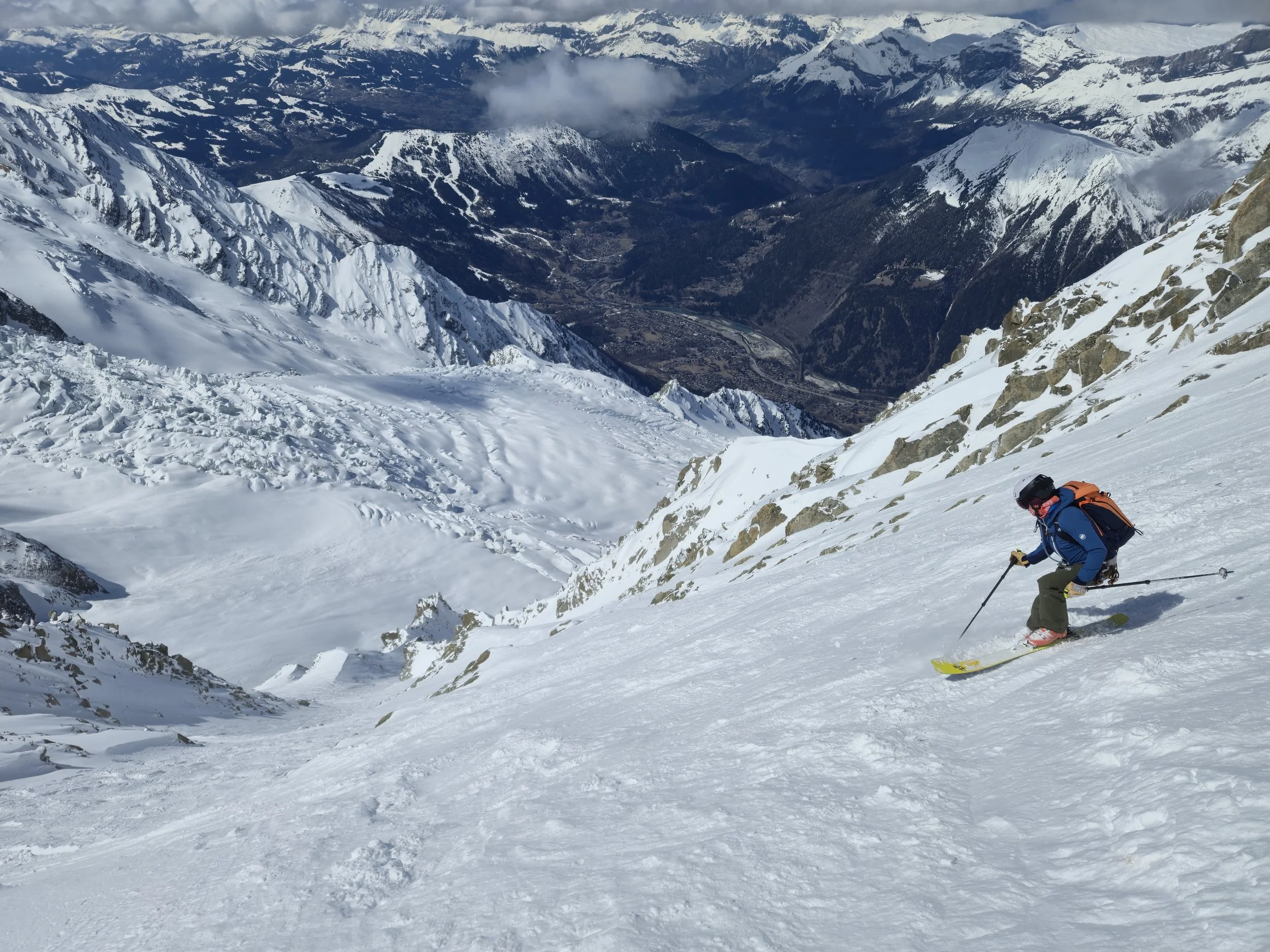
AIARE 2 Course on Mount Washington, New Hampshire
Develop a deeper approach to avalanche terrain, observations, leadership, and uncertainty with an AIARE 2 course in New Hampshire. AIARE 2 is advanced recreational avalanche education for backcountry travelers who already have foundational training and experience applying those skills in the field.
The course builds on the decision-making framework introduced in AIARE 1 and asks students to apply it to more complicated terrain, changing conditions, incomplete information, and leadership within a small backcountry team. Core Mountain Guides teaches AIARE 2 in the Mount Washington region of New Hampshire's White Mountains.
Comparing avalanche courses? See the complete AIARE course progression in New Hampshire.
What You Learn in AIARE 2
During the course, students develop skills for:
Identifying where specific avalanche problems exist in the landscape
Recognizing terrain where avalanche consequences may be greater
Gathering relevant weather, snow, and avalanche observations
Connecting field observations with terrain choices
Evaluating gaps in available information
Managing uncertainty during trip planning
Adjusting plans as new information becomes available
Facilitating group discussion and consensus
Leading a small backcountry team
Using simple forecasting and risk-management tools
Applying the AIARE framework in unfamiliar situations
The course places greater responsibility on students to develop observations, form opinions, communicate reasoning, and participate in leadership.
What Is an AIARE 2 Course?
AIARE 2 is the next stage of recreational avalanche education after Level 1, Avalanche Rescue, and practical backcountry experience.
AIARE 1 introduces a framework for managing avalanche risk.
AIARE 2 goes deeper into situations where the answer is less obvious.
Students learn to recognize important gaps in available information, gather useful observations, interpret weather and snowpack information, evaluate terrain more carefully, and lead group decision-making while uncertainty remains.
The objective is not to eliminate uncertainty.
It is to recognize it, communicate it, and make terrain decisions that account for it.
Managing Uncertainty in Avalanche Terrain
One of the central themes of AIARE 2 is uncertainty.
Avalanche decisions are rarely made with perfect information.
The local forecast may not describe exactly what is happening on the slope in front of you. Conditions may vary across elevation or aspect. Wind loading may have changed overnight. A snowpack observation may answer one question while raising another.
Students learn to identify what they know, what they do not know, and which pieces of missing information matter to the decision.
From there, the group can decide whether to gather additional information, modify the route, increase margins, or choose different terrain.
Terrain Assessment and Consequence
AIARE 2 asks students to think beyond whether terrain is simply capable of producing an avalanche.
Different pieces of avalanche terrain create different exposure and consequences.
Students examine how terrain shape, slope position, aspect, elevation, runout, terrain traps, route options, and escape possibilities affect the consequences of a terrain choice.
The goal is to develop a more detailed terrain mindset and a larger range of options for responding to changing conditions.
Weather, Snowpack, and Avalanche Observations
AIARE 2 develops a more detailed understanding of the relationship between weather, snowpack processes, avalanche problems, and terrain.
Students practice gathering observations for a purpose rather than simply collecting data.
Questions might include:
Where is the avalanche problem likely to exist?
Which terrain characteristics matter today?
What observations could confirm or challenge our current understanding?
What information is relevant to the terrain we intend to travel through?
How much uncertainty remains?
Snow observations become another tool in the decision-making process rather than an end in themselves.
Leadership and Group Decision-Making
AIARE 2 also places additional emphasis on leadership.
Backcountry leadership does not mean making every decision for the group.
It includes facilitating discussion, encouraging relevant observations, identifying disagreement or uncertainty, using established decision-making tools, and helping the group reach clear terrain decisions.
Students rotate through planning, observation, communication, and leadership roles throughout the course.
That creates an opportunity to receive coaching not only on avalanche knowledge but on how effectively that knowledge is used within a team.
Who Should Take AIARE 2?
AIARE 2 is intended for experienced recreational backcountry travelers who want to advance beyond foundational avalanche education.
It is appropriate for students who have already spent meaningful time applying the AIARE framework on personal backcountry trips and want additional coaching in more complicated situations.
This course may be appropriate if you want to become better at:
Planning trips when information is incomplete
Understanding where avalanche problems exist in the terrain
Connecting snow and weather observations with terrain decisions
Traveling in unfamiliar or more complicated terrain
Leading a small backcountry group
Communicating uncertainty
Developing your judgment through coached experience
AIARE 2 Prerequisites
Students should have completed foundational Level 1 avalanche education and an approved Avalanche Rescue course.
They should also have practical experience traveling in avalanche terrain after their Level 1 course.
AIARE strongly recommends gaining substantial backcountry experience between Level 1 and Level 2 so students arrive prepared to build on skills they have already practiced independently.
Participants must also be capable of full winter backcountry days and efficient travel on touring equipment.
AIARE 2 Course Format
Core Mountain Guides delivers AIARE 2 through pre-course preparation, an evening online session, and two field days.
Before the Field Sessions
Students review prior AIARE concepts and begin evaluating the seasonal snowpack and available avalanche information.
Evening Zoom Session
The group discusses current conditions, reviews important Level 1 concepts, and begins planning for the field portion of the course.
Two Field Days
Students apply the AIARE framework while gathering observations, evaluating terrain, communicating uncertainty, making plans, and practicing leadership.
The field days are intentionally participatory. Students should arrive prepared to contribute observations, opinions, questions, and decisions.
AIARE 2 on Mount Washington
The Mount Washington region provides an excellent environment for advanced recreational avalanche education because students can work with real mountain weather, avalanche forecasts, wind-affected snow, complex terrain, and changing travel conditions.
Field locations are selected according to current conditions and course objectives.
Students should not expect to follow a predetermined tour.
The terrain itself is part of the curriculum, and route choices may change as the group gathers information and evaluates uncertainty.
That decision-making process is one of the most important parts of the course.
Train With an IFMGA Mountain Guide
AIARE 2 courses with Core Mountain Guides are led by Paul Rachele, an IFMGA Mountain Guide and AIARE Course Leader with professional experience in avalanche forecasting, avalanche education, ski guiding, ski mountaineering, and technical mountain travel.
AIARE 2 is particularly well suited to an instructional approach based on coached decision-making.
Rather than simply receiving information, students take an active role in planning, observations, leadership, communication, and terrain choices.
Frequently Asked Questions About AIARE 2
-
AIARE 1 introduces a repeatable framework for managing avalanche risk. AIARE 2 builds on that framework and develops additional tools for evaluating conditions, terrain, consequences, leadership, and uncertainty in more complicated situations.
-
AIARE recommends gaining at least a season of practical backcountry experience between Level 1 and Level 2. The course works best when students have already used the AIARE framework independently and have real experiences and questions to build on.
-
Yes. An approved Avalanche Rescue course is part of the prerequisite progression for AIARE 2.
-
No. AIARE 2 is advanced recreational avalanche education. It can be valuable preparation for people considering professional avalanche education, but it is not a professional avalanche forecasting certification.
-
Snow and snowpack observations can be part of AIARE 2, but the objective is not simply to learn how to dig pits. Students learn to choose observations that address specific questions and connect the information they gather to terrain and travel decisions.
-
Consider how much experience you have applying Level 1 concepts on your own trips. If you are still developing basic trip planning, terrain recognition, or rescue skills, additional practice may provide more value before taking Level 2. For a side-by-side explanation of the progression, see our guide to avalanche courses in New Hampshire.
Advance Your Avalanche Decision-Making
AIARE 2 is an opportunity to move beyond foundational avalanche education and receive coaching while making decisions in more complicated situations. You will leave with additional tools for evaluating terrain, gathering useful observations, communicating uncertainty, and leading a backcountry team.

2027 Schedule
February 13-14 (Evening Zoom (2/11)
Contact Core if a program is full or for custom dates.